
Claude can remember more than most setups let it. Measure how much of your context, standards and best work actually survives into the next session. The gap has a price: find out roughly what it is, free, in two minutes.
The free check takes two minutes and needs no email. The full interview is free for the first cohort, by invite. The pack is $99, with a 14-day refund if it plainly does not fit.
Your rough score, in two minutes
Eight honest questions, scored against six of the seven categories on the full rubric. The number appears right here; no email needed.
A good fit, honestly
A good fit when
- Claude is part of your work every week
- You repeat client or operational workflows
- You are willing to maintain a small set of files and operating rules
- You want a setup a colleague could take over
Probably not a fit when
- You use Claude occasionally for one-off questions
- You do not want to touch local files or Claude Code
- Your organisation requires centrally approved enterprise deployment
- You already maintain a sophisticated audited configuration
How it works
Three steps, most of it done for you.
The interview
About 20 minutes, mostly multiple choice: your role, surfaces, tools, workflows, memory habits and goals. Twenty-one questions across all seven categories, where the free check guesses from eight.
Free, by inviteYour results
Your score and report appear as soon as you complete the interview: a band on a 100-point scale across seven categories, your top three gaps named plainly, and what they cost you day to day. Estimated, and honest about that.
IncludedYour personalised pack
A zip of runbooks assembled for your profile from a tested 28-runbook library, human-reviewed within 48 hours. Your own Claude executes them; its audit runbooks turn the estimate into a measured score, starting with a read-only foundation audit.
$99Three gaps, named plainly
A scored picture of your setup and the specific things costing you the most, in order. These are illustrative examples; your report names yours.
Foundation
The basics of a durable Claude setup are not yet in place.
Day to day: every new session starts from a blank page, so time goes on re-explaining instead of working.
Memory and context
What Claude learns in a session does not reliably survive to the next one.
Day to day: context gets rebuilt by hand each time, and decisions made weeks ago are easy to lose.
Advanced capability
Sub-agents, scheduled runs and headless use are not yet part of the working pattern.
Day to day: work that could run unattended still needs someone at the keyboard to kick it off.
Your pack, once you buy it
- Assembled to your profile from the 28-runbook library, never generated fresh
- Planned in three tiers, Start here, This week and Later, so you always know the next task
- Written Claude Code first; on a browser-only profile five of the roughly twenty runbooks run entirely in claude.ai and the rest need Claude Code, a free desktop tool included with the plan you already pay for
- Every runbook carries a verify check, so you know it worked before moving on
- A 33-page companion guide, designed and printable, explaining every concept your runbooks touch, from git to vector databases, with a glossary at the back; the same material also ships as markdown so your Claude can read it mid-task
- A scoreboard that tracks your pack progress; the audit runbooks measure your score
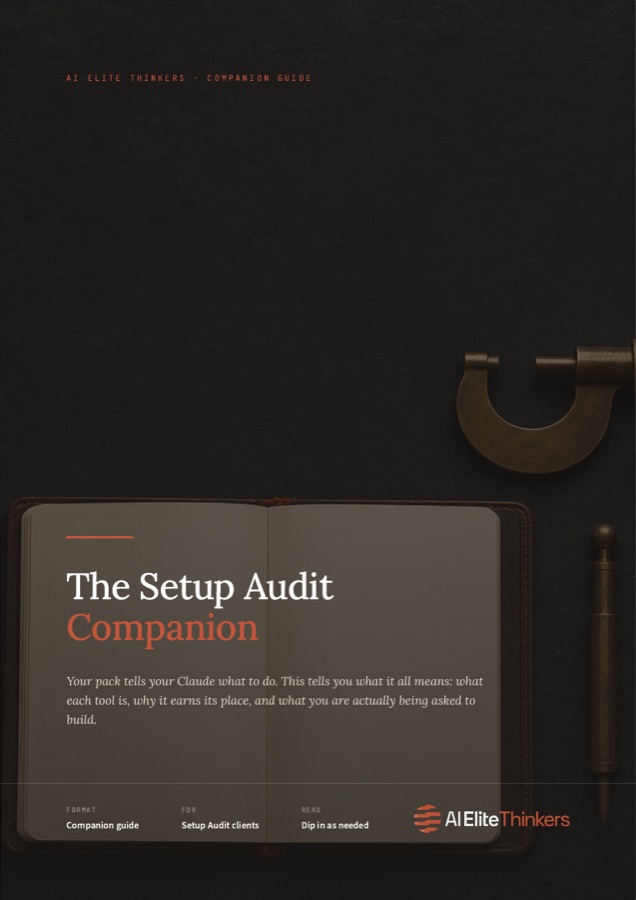
The Setup Audit Companion
Your pack tells your Claude what to do. The companion tells you what it all means: what each tool is, why it earns its place, and what you are actually being asked to build. Thirty-three designed pages covering the terminal, CLAUDE.md, git, permissions, models, memory tiers, vector databases, Obsidian, MCP, skills, subagents and scheduling, with a 26-term glossary at the back.
Written for someone who does not already know what a repository or a namespace is. The same book ships with every pack, on screen or printed.
Read a sample chapter (PDF, 2 pages)Could you just ask Claude to do this?
Yes. Here is what that gets you, and what it does not.
Ask Claude to audit your own setup and you get a thoughtful one-off answer, framed by whatever you thought to ask, scored against no particular standard, gone when the chat ends. Self-report has a known failure mode: everyone believes their setup is roughly fine, which is why audits exist as a discipline.
What you are paying for here is the standard: a published 100-point rubric, runbooks that have already been run and checked on their intended Claude surface, assembly against your actual answers, and a human read before anything ships. None of that needs taking on faith; the artefacts are published:
- The complete sample report: the exact format buyers receive, generated from a fixture profile.
- One complete runbook: every step and its verify check, exactly as it ships in a pack.
- The full scoring rubric: every criterion, weight and rule, nothing held back. Score yourself by hand if you like.
- A chapter of the companion guide: two pages of the 33-page book that ships in every pack.
If you read those and conclude your own prompt gets you there, that is a fine outcome and we mean it. The free check is still yours.
A published, versioned standard you can inspect
Your score comes from a 100-point rubric across seven categories, weighted by what compounds most. Foundations and memory carry the most, because everything else builds on them.
points, seven categories, weighted by what compounds most.
Setup Rubric v1.2, reviewed 2026-08-04. Read the published rubric: every criterion, weight and rule.
See where you land on it, freeWhere do you sit?
Five bands, 100 points. The interview places you on this ladder and names what is holding you at your band.
Take the band ladder as a one-page reference; prints cleanly to A4.
Honesty is the brand
Your interview score is a band from self-reported answers, not fake precision. The pack’s audit runbooks are read-only checks your own Claude runs locally, turning the estimate into a measured score, category by category.
There is no OAuth path onto your Claude setup and we do not ask for your login. The interview asks; your own Claude inspects, on your own machine, when you choose to run it.
Runbooks are plain markdown. Nothing installs itself and nothing runs unattended; you read it, then your Claude executes it with you in the loop.
A 20-minute self-report earns you an estimate, not a certainty. We say which is which.
Who is behind the standard
Built by Jamie Whitson, a PwC-trained auditor and former Head of Finance across property, hospitality and entertainment. The Setup Audit exists for professionals who need AI systems they can inspect, govern and defend, not just impressive outputs.
Pricing, plainly
Not a course, not consulting hours: a diagnosis and the runbooks that guide and verify the fix. The diagnosis is free; you pay only if you want the fix.
- About 20 minutes, one question at a time
- Mostly multiple choice, skip what you are unsure of
- Your score, band and top three gaps, named plainly
- Runbooks assembled to your profile from the 28-runbook library
- Audit runbooks that turn your estimate into a measured score
- Plain markdown, verify checks throughout, yours to keep
Asked before buying
Why is the interview invite-only rather than just open?
The founding cohort is capped at 25 setups so every report and pack receives a human review. A limited number of links go out each day: leave an email and, if one is left, your link appears on the spot. If the day's links have gone, your request is recorded and the link is sent by hand. The free check needs no invite and no email.
Do you access my Claude account?
No. We never connect to or inspect your Claude account remotely, and we do not ask for your login. Your own Claude runs the pack's audit runbooks locally, when you choose to.
Why not just ask Claude to audit itself for free?
You can. What you are buying is the rubric (a tested 100-point scoring standard), a library of runbooks that already work, assembly against your actual answers, and a human review before delivery. The rubric, the complete sample report and a complete sample runbook are published on this page; read them before paying anything.
What do I need to use the pack?
A Claude plan. The pack is written Claude Code first; that is where runbooks that touch files and skills earn their keep. Browser-only: five of the roughly twenty runbooks you would be sent run entirely in claude.ai, and the rest write files on your own machine. Claude Code is a free desktop tool included with the plan you already pay for, and you write none of the setup yourself. Pick your surface on the free check above and it says the same thing on your result, before you give us an email address.
Is my interview data safe?
Your answers form a profile used to score you and assemble your pack. It contains no passwords or keys by design (we never ask for them). Stored securely, deleted on request, and any benchmark use is anonymised.
Is the free check the same as the interview score?
No, and we will not pretend it is. The check is a rough guess from eight self-graded answers, one band of margin either side. The interview estimates properly across all seven categories, and the pack's audit runbooks evidence-check the estimate on your machine, category by category. Guess, estimate, evidence-checked: in that order.
How is the score calculated?
A 100-point rubric across seven categories (foundations, memory, skills, integrations, productisation, control and safeguards, advanced use), weighted by what compounds most. From interview answers alone you get a band with a stated margin; running the pack's audit runbooks on your machine evidence-checks it, category by category.
What exactly is in the pack?
Step-by-step runbooks your Claude executes, each with verify checks, assembled for your profile from the tested 28-runbook library, plus a scoreboard page. The audit runbooks, not the ticks, measure your score.
What if I already score high?
Then the report says so, and the pack leans into what is left: usually productisation and the advanced tier. A high scorer gets fewer, harder runbooks rather than padding.
Find out what you are actually running.
About 20 minutes, one question at a time. Free while the first cohort is open.
Request my free interview inviteAlready have an access link? Go straight to the interview.